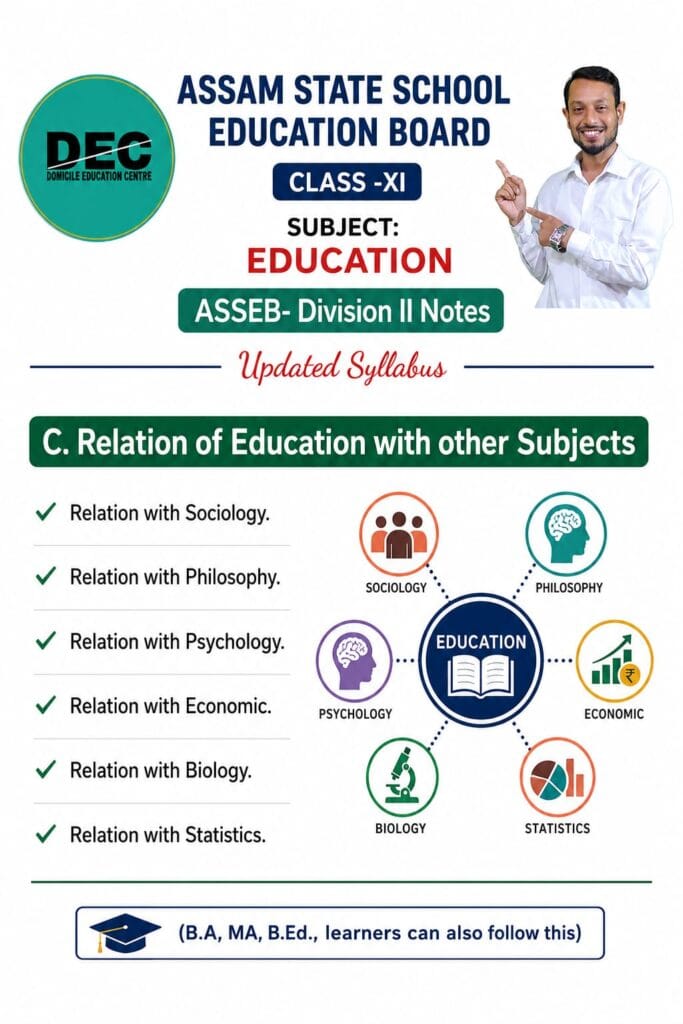
Relation of Education With Philosophy, Sociology, Psychology.
Chapter-1 Concept and Aims of Education
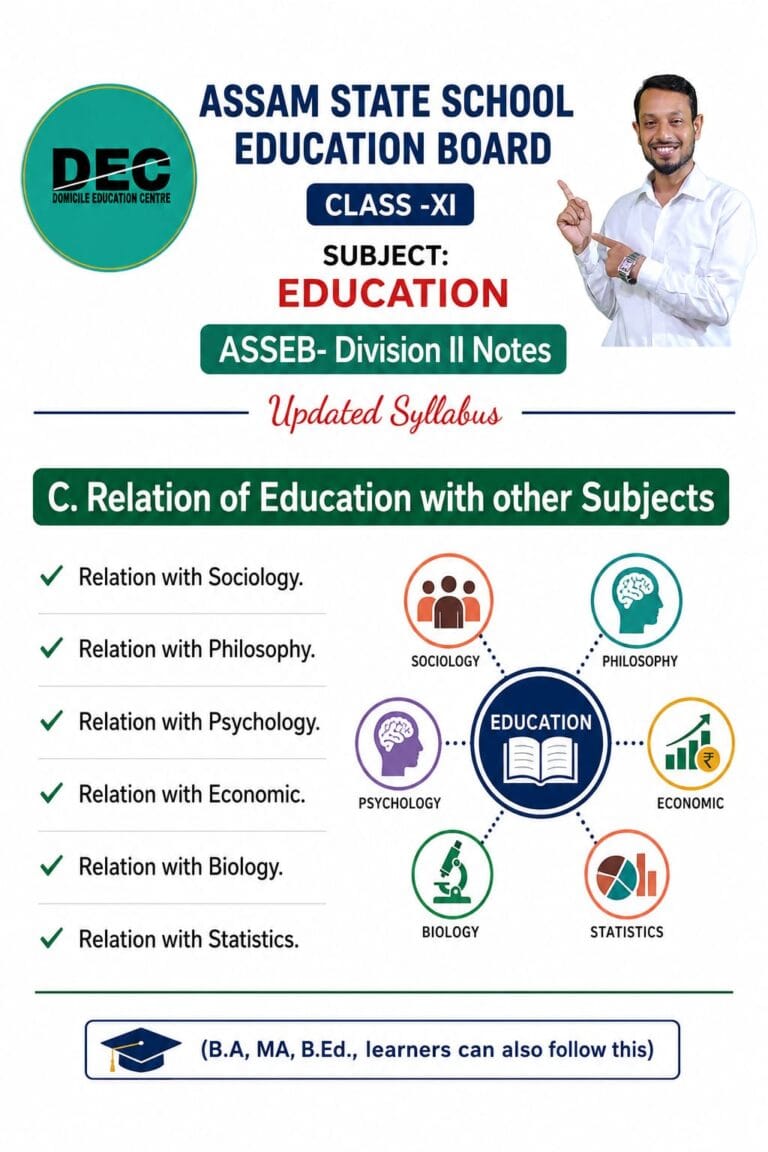
Relation of Education With Philosophy, Sociology, Psychology, Economics, Biology and Statistics.
29. Explain the relationship between Education and Sociology.
Ans: Education and sociology are closely related. Sociology is the scientific study of society, social relationships, institutions, and culture, while education is the process through which knowledge, values, skills, and culture are transmitted from one generation to another.
The relationship between education and sociology is explained through the following points:
(i) Education is a Social Process:
Education takes place within society and helps individuals learn social norms, values, and customs.
(ii) Education Transmits Culture:
Through education, the culture, traditions, beliefs, and values of a society are passed on to the younger generation.
(iii) Education Promotes Social Development:
Education helps bring social about social progress, reforms, and development by creating informed and responsible citizens.
(iv) Society Influences Education:
The aims, curriculum, and methods of education are influenced by the needs and values of society.
(v) Education helps Social Adjustment:
It prepares individuals to adjust successfully to social life and perform their social responsibilities.
(v) Education Maintains Social Order:
By teaching discipline, cooperation, and moral values, education helps maintain peace and stability in society.
Conclusion:
Education and sociology are independent. Sociology helps us understand society, while education helps preserve and improve society. Therefore, both work together for the development of individuals and society.
xxxxx
30. Discuss the relationship between Education and Philosophy.
Ans: Education and philosophy are closely related. Philosophy provides the ideals, values, and aims of life helps in achieving those ideals through the teaching-learning process. Therefore, Philosophy and education are independent.
The relationship between education and philosophy is explained through the following points:
(i) Philosophy Determines the Aims of Education:
Philosophy helps in deciding the goals and objectives that education should achieve.
(ii) Philosophy Influences the curriculum:
The content of education is selected according to philosophical beliefs and values.
(iii) Philosophy Guides Teaching Methods:
Different philosophies suggest different methods of teaching and learning.
(iv) Philosophy Shapes Educational Values:
Education develops moral, social, and spiritual values based on philosophical principles.
(v) Education Applies Philosophy in Practice:
Education translates philosophical ideas and theories into practical experiences.
(vi) Both Aim at Human Development:
Philosophy and education work together for the all-round development of an individual.
Conclusion:
Education and philosophy are inseparable. Philosophy provides direction and purpose to education, while education puts philosophical ideas onto practice. Together, they help in the development of individuals and society.
xxxxx
31. Explain the relationship between Education and Economics.
Ans: Education and economics are closely related. Economics studies the production, distribution, and consumption of wealth, while education develops the knowledge, skills, and abilities needed for economics activities. Education is considered an investment in human resources that contributes to economic growth and development.
The relationship between Education and Economics are as follows:
(i) Education develops Human Resources:
Education equips individuals with knowledge and making them productive members of society.
(ii) Education Increase Productivity:
Educated people can use modern technology and methods more efficiently, leading to higher productivity.
(iii) Economic Influence Education:
The economic condition of a country affects educational planning, funding, and facilities.
(iv) Education Promotes Employment:
It prepares individuals for different occupations and improves their employment opportunities.
(v) Education Reduces Poverty:
By improving skills and employability, education helps people earn better incomes and improve their standard of living.
(vi) Education Support Economic Development:
Skilled and educated citizens contribute to industrial, agricultural, and technological development.
(vii) Economics Helps in Educational Planning:
Economics principles help governments allocate resources and plan educational programs effectively.
Conclusion:
Education and economics are independent. Education contributes to economic growth by developing skilled human resources, while economic provides the resources necessary for the development of education. Together, they play a vital role in national development.
xxxxx
32. Explain the relationship between Education and Psychology.
Ans: Education and psychology are closely related. Psychology is the scientific study of human behaviour and mental process, while education is the process of teaching and learning. Psychology helps educators understand learners, making the teaching-learning process more effective.
The relationships between education and psychology are as follows:
(i) Psychology Helps Understand the Learners:
Psychology provides knowledge about the nature, needs, interests, and abilities of learners.
(ii) Psychology Improves Teaching Methods:
Psychological principles help teachers select suitable methods of teaching according to the age and ability of students.
(iii) Psychology Helps in Curriculum Development:
Educational programmes and curricula are designed based on the psychological needs and interests of learners.
(iv) Psychology Aids Learning:
It explains how learning takes place and helps improve learning outcomes.
(v) Psychology Helps in Evaluation:
Psychological tests and measurement techniques help students’ abilities, intelligence, and achievement.
(vi) Psychology Helps Solve Educational Problems:
It helps teaches understand and solve behavioural, emotional, and learning difficulties of students.
(vii) Education Applies Psychological Principles:
Education uses psychological knowledge in classroom teaching and learning activities.
Conclusion:
Education and psychology are interdependent. Psychology provides scientific knowledge about learners and learning, while education applies this knowledge in practice. Together, they help improve the teaching-learning process and ensure the overall development of students.
xxxxx
33. Discuss the relationship between Education and Statistics with suitable example.
Ans: Education and Statistics are closely related. Statistics is the science of collecting, organizing, analysing, and interpreting numerical data. In education, statistical methods are used to study educational problems, evaluate students’ performance, and improve the teaching-learning process.
The relationships between Education and Statistics are as follows:
(i) Statistics Helps in Educational Research:
Statistics is used to collect and analyse data in educational research.
Example: A researcher may use statistical methods to study the effectiveness of a new teaching method.
(ii) Statistics Helps in Student Evaluation:
It is used to measure and evaluate students’ academic performance.
Example: Examination marks, grades, and class average are calculated using statistical techniques.
(iii) Statistics Helps in Educational Planning:
Educational authorities use statistical data for planning and decision-making.
Example: The number of schools, teachers, and students in a district is analysed for future planning.
(iv) Statistics Helps in Measuring Intelligence and Achievement:
Psychological and achievement tests are interpreted with the help of statistics.
Example: IQ score and achievement test results are analysed statistically.
(v) Statistics Helps in Comparing Educational Performance:
It enables comparison between students, schools, and educational programmes.
Example: Comparing the pass percentages of different schools.
(vi) Statistics Helps in Identifying Educational Problems:
Statistical analysis helps identify weakness and challenges in education.
Example: High dropout rates in a particular area can be identified through statistical data.
(vii) Education provides Data for Statistics:
Educational institutions generate a large amount of data that can be analysed statistically.
Example: Attendance records, examination results, and enrolment data.
Conclusion:
Education and Statistics are interdependent. Statistics helps in educational research, evaluation, planning and decision-making, while education provides valuable data for statistical analysis. Therefore, statistics plays an important role in improving the quality and effectiveness of education.
xxxxx
34. Explain the relationship between Education and Biology.
Ans: Education and biology are closely related. Biology is the science that studies living organisms and their life process, while education is the process of developing an individual’s knowledge, skills, and abilities. Biological knowledge helps educators understand the physical and mental growth of learners and organize education accordingly.
The relationship between education and biology are as follows:
(i) Biology Helps Understand Child Growth and Development:
Biology provides knowledge about the physical growth and development of children at different stages.
(ii) Biology Helps in Understanding Individual Differences:
Biological factors such as heredity and environment influence the ability and behaviour of learners.
(iii) Biology Contributes to Health Education:
Knowledge of biology helps students learn about health, hygiene, nutrition, and disease prevention.
(iv) Biology Helps in Curriculum Planning:
Educational programmes are designed according to the biological needs and development stages of learners.
(v) Biology Supports Physical Education:
Understanding the structure and functions of the body helps in organizing physical activities and supports.
(vi) Biology Helps in Understanding Learning Readiness:
Biology maturity affects a child’s readiness to learn different skills and subjects.
(vii) Education Applies Biological Knowledge:
Educational practices use biological to promote the healthy growth and development of learners.
Conclusion:
Education and Biology are interdependent. Biology provides knowledge about human growth, development, health, and heredity, while education uses this knowledge to make teaching and learning more effective. Therefore, biology plays an important role in achieving the aims of education.
xxxxx
(N.B. Class-xi students should write at least 5 points for a 5-mark question)
Recent Comments